Family-run business that has been established for over 40 years
- info@glassonmetalworks.co.uk
- 01707 262662
- Fax: 01707 262663
Steel Fabrication
Steel fabrication refers to the building of machines, structures and other equipment, by cutting, shaping and assembling components made from raw materials.
Steel fabrication shops and machine shops have overlapping capabilities, but fabrication shops generally concentrate on the metal preparation, welding and assembly aspect while the machine shop is more concerned with the machining of parts.
Wrought Iron
Wrought iron is commercially pure iron. In contrast to steel, it has a very low carbon content. Wrought iron is tough, malleable, ductile and easily welded.
Before the development of effective methods of steelmaking and the availability of large quantities of steel, wrought iron was the most common form of malleable iron.
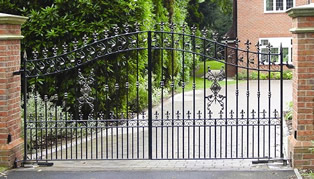
Many products described as wrought iron, such as guard rails and gates, are made of mild steel. They retain that description because they were formerly made of wrought iron or have the appearance of wrought iron. True wrought iron is required for the authentic conservation of historic structures.
Forge
A forge is the workplace of a smith or a blacksmith. A forge is sometimes referred to as a smithy.
The basic smithy contains a forge, also known as a hearth, for heating metals. The forge heats the workpiece to a malleable temperature or to the point where work hardening no longer occurs.
Welding/Welders
Welding is a fabrication or sculptural process that joins materials, usually metals or thermoplastics, by causing coalescence. This is often done by melting the workpieces and adding a filler material to form a pool of molten material (the weld pool) that cools to become a strong joint, with pressure sometimes used in conjunction with heat, or by itself, to produce the weld.
Glasson Metalworks Limited |
T: 01707 262662 |
|
F: 01707 262663 |
||
info@glassonmetalworks.co.uk |
||
We are based in a forge on a farm so are not always easy to find on map or with satnav. Here are some directions that may help you:
From A1(M)Leave A1(M) at Junction 4 and take exit for Stanborough, A6129, keep in left hand lane. At next roundabout (with boat on it!) take the first exit, passing underneath the motorway bridge. At next roundabout take first exit into Great North Road (this will be marked as a dead end, but trust me ….) look for sign indicating Stanborough Forge At the end of Great North Road, there is a track that leads up to Stanboroughbury Farm. We are the first building on the left once you get to the top of the track. |
From A414Follow directions for A1(M). As you pass Tesco on your left, get into right hand lane and take exit for A6129, keep in the left hand lane. At next roundabout (with boat on it!) take the first exit, passing underneath the motorway bridge. At next roundabout take first exit into Great North Road (this will be marked as a dead end, but trust me ….) look for sign indicating Stanborough Forge At the end of Great North Road, there is a track that leads up to Stanboroughbury Farm. We are the first building on the left once you get to the top of the track |
Glasson Metalworks is a family-run business that has been established for over 40 years in Welwyn Garden City, Hertfordshire. We are currently based at Stanborough Forge on Stanboroughbury Farm.Read More
Tel: 01707 262662
Email info@glassonmetalworks.co.uk
Stanborough Forge,
1a Stanboroughbury Farm
Great North Road
Welwyn Garden City
Hertfordshire AL8 7TD